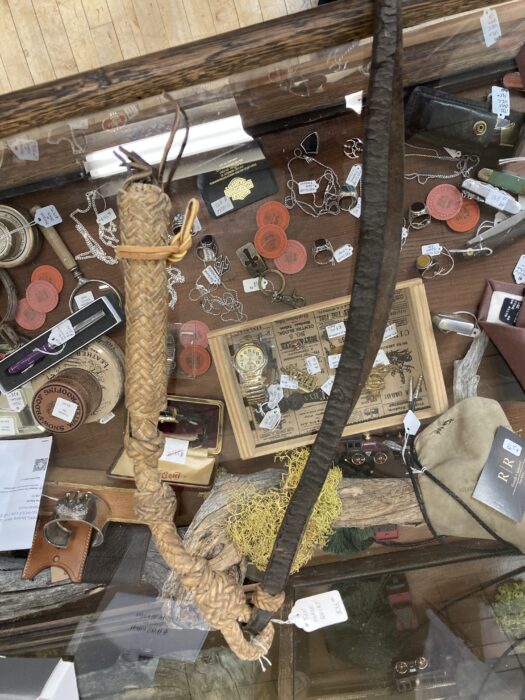
This fall/winter I haven’t gotten a lot of bullwhip cracking in due to my schedule and the weather. It seems like whenever I have a free day it’s either raining, or has just stopped raining.
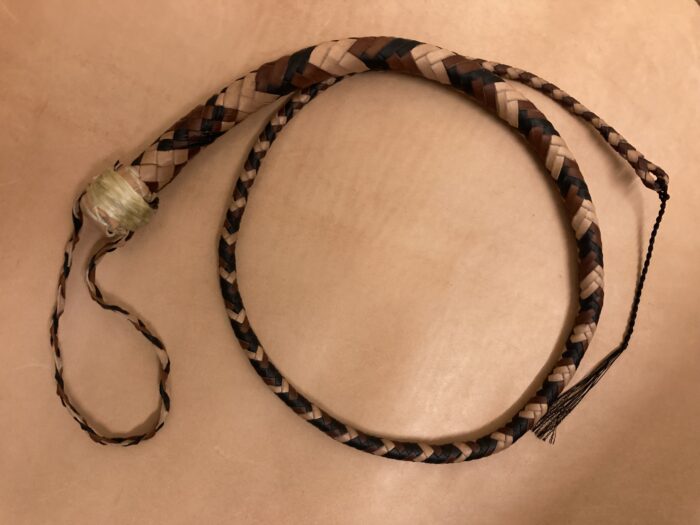
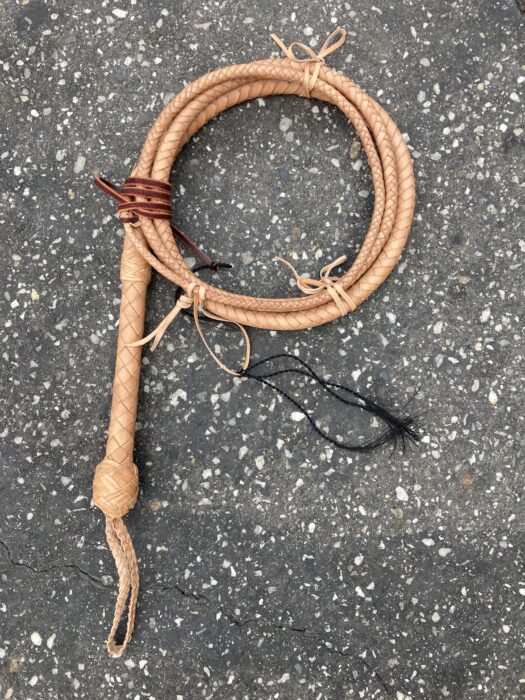
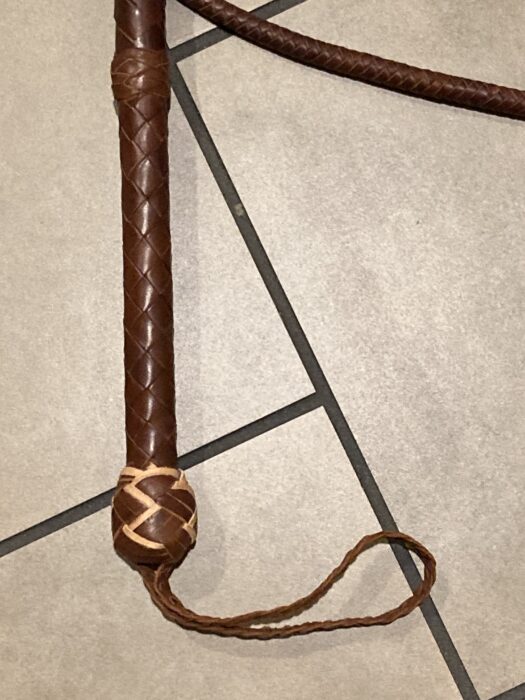
Today I got out and gave my bullwhips a bit of a workout. I’m breaking in a pair of two tone bullwhips that I had made for myself a while ago. They are starting to break in nicely, but need more time.
While I was out I was messing about with a fun combination of cracks. I was using the following cracks (all two handed):
* Volleys with both hands
* Volley in left hand and arrowhead in right
* Volley in right hand and arrowhead in left
* Arrowhead in both hands
By mixing combinations of the above cracks you can end up with some fun combinations of things. Like doing one arrowhead crack across the body and back, then doing an arrowhead with the other hand. the hand that’s not doing the arrowhead is doing a volley. I hope that makes sense how I wrote it.
Next time I’m out I’ll try to remember to bring the camera and take some pictures.
Right now I’m making a 12 plait signal whip and the overlay is almost finished. I was just looking at it and admiring my strand drops in this particular whip. That got me thinking about dropping strands in a bullwhip.
If you haven’t made a whip, or don’t know what a strand drop is, basically it’s when you take plaits out of the whip (or more accurately drop them into the middle of the whip) to reduce the overlays diameter.
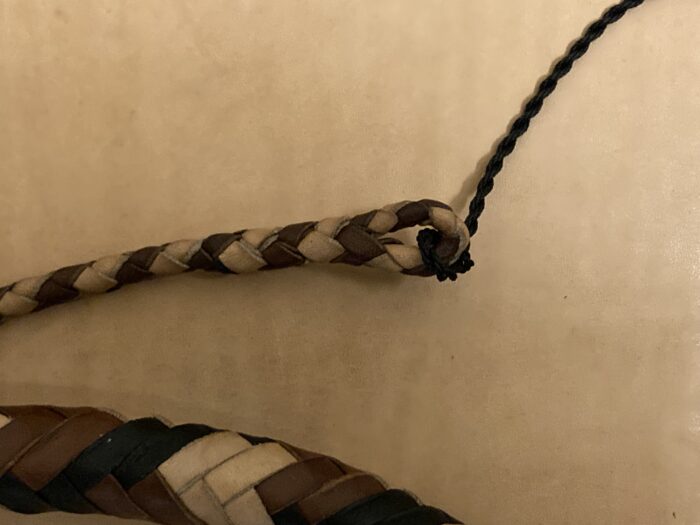
For example an Indiana Jones style bullwhip (like David Morgan’s) starts as a 12 plait (12 strands) at the handle and ends with only 6 strands at the fall hitch. The 6 strands that disappeared between the beginning and the end were dropped into the middle of the whip.
Having good technique for dropping strands will give you a whip that when coiled doesn’t have kinks in it and will help give the whip a nice taper.
For me the hardest part about strand drops was to avoid:
Having a bump at the strand drop
Having a dramatic decrease in diameter at the strand drop
Kinks in the whip when coiled
A long time ago I used to cut out filler strands equal to the strand about to be dropped in to reduce the bump in the whip. This took away the bump, but gave me a sharp decrease in the whips taper (David Morgan scolded me for that one time, but helped me fix it!). What I currently do is cut out approx 1/2 of what I’m dropping into the bullwhip.
Also I’m dropping one strand from the front and one from the back of the plaiting at the same point. What that does is gives me to opposing small kinks in the whip that almost cancel each other out. If you drop to strands at the same point on the same side of the whip, you put two slightly weak spots together and it gives you one larger weak spot and a more visible kink in the whip.
There is more to it that that, and a lot of it is plaiting technique or knowing when to drop a strand. I know there are other ways to do this, this is how I figured it out to give my whips a smoother taper and coil.
Today I’ll be finishing up a 4 foot 12 plait signal whip. All that is left for me to do on it is shellac it.
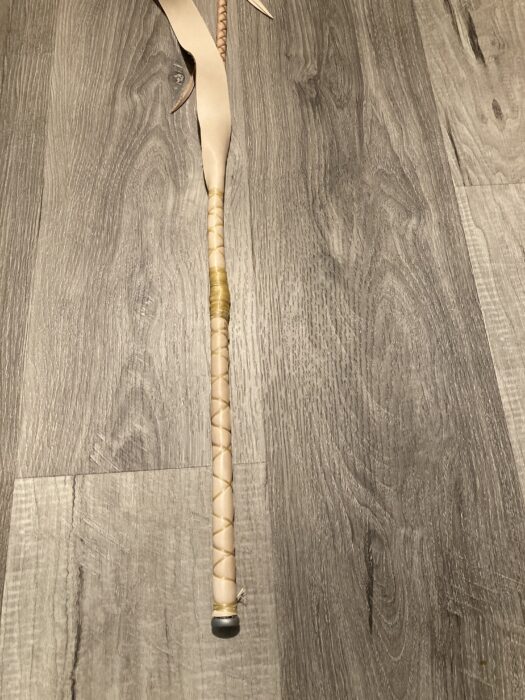
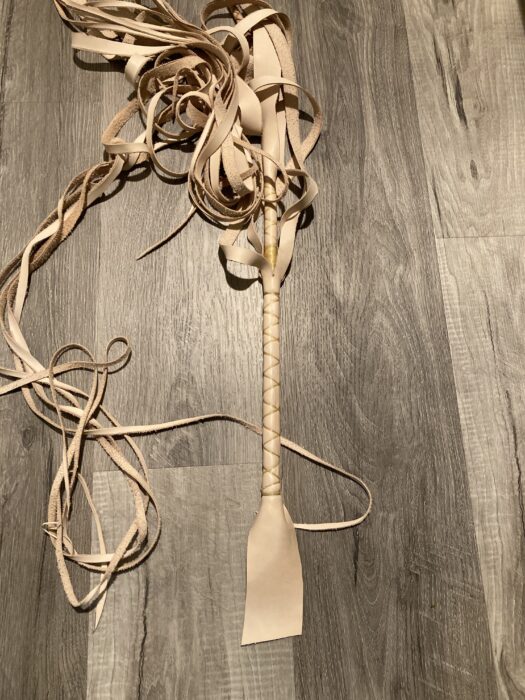
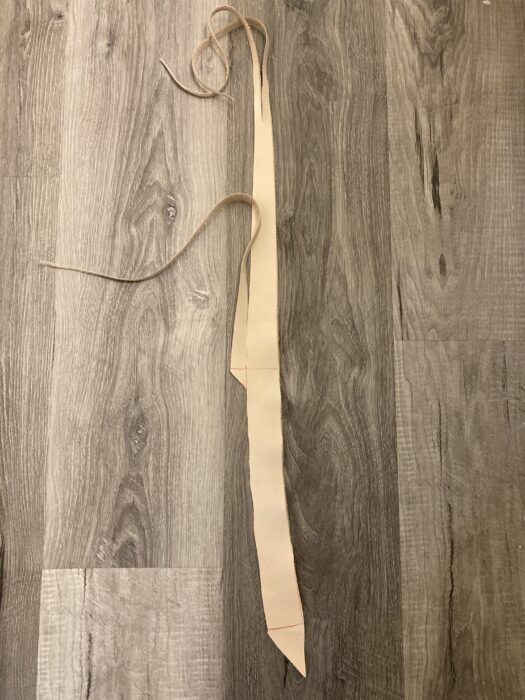
My next project is to make a quirt. Quirts are something that I’ve wanted to make for a while, I’ve just never done it. I remember the first time I’d ever seen a quirt, it was a Joe Strain’s workshop, he had one that he was plaiting an name or initals into. Once again I thought that the looked pretty cool and have wanted to try to make one ever since
I don’t know a lot about Quirts, but after some reading on the internet and looking at a ton of pictures (thank you google images!), I’ve come up with a bit of a plan for one. It seems there are two kinds of quirts: a dog quirt and an horse quirt. From what I can tell the main difference is length. The dog quirts are shorter about 30 inches total and the horse quirts are about 10 inches longer.
From what I’ve read they generally don’t have a rigid handle, however in Bruce Grant’s book he describes one that does have a rigid bit of a handle. My current plan it to do make one with a shotloaded core (no rigid handle). In the future I might put a rawhide core in one to give it a rigid handle.
If you know anything about making quirts feel free to let me know anything that might be useful!
Yesterday I got back to making some whips after my vacation. My current project is working on a 4 foot signal whip in 12 plait black kangaroo. Yesterday the kangaroo arrived for this whip (along with another kangaroo skin):
Black roo
Natural Tan Kangaroo
Plaited belly for signal whip
Currently the signal whip has it’s shot bag and plaited belly finished. Today I’ll work on the overlay. With a bit of luck it will be ready to ship out tomorrow.
Also if you are in the Seattle area, I’m performing tonight at a Jazz Club called Egan’s Ballard Jam House. It’s a cool little 45ish seat club that normally has Jazz music, but is doing a magic show tonight. Here’s the write up from the local newspaper about the show:
Magical night to come at Egan’s
By Steve Shay
February 1, 2010
Egan’s Ballard Jam House
Egan’s Ballard Jam House, known for its jazz performances, will do a bit of hocus-pocus Feb. 2, as it offers “That’s Impossible!” a magic/comedy show.
Rick Anderson and Louie Foxx join Ballard performer Tony Comito for an evening of close-up magic with audience participation.
“Louie Foxx does a trick whip-cracking act which is probably something you would not see on stage in Omaha,” said Comito. “You can’t go wrong with whip-cracking.”
Foxx also does unusual hand shadows.
“Things you’ve never seen before, not a crocodile or rabbit, but quite phenomenal things,” said Comito. “That’s true of everything you’re going to see.”
Anderson will involve the audience with his close-up, slight-of-hand.
“This is a great venue for performing magic,” said Comito. “With seating for 45, the magicians have the attention of the audience. Often we perform at parties, walking around and performing to small groups of guests that can become easily distracted.”
Reservations are encouraged. There is a $10 cover. Egan’s, located at 1707 N.W. Market St., will be open for dinner and they offer a full bar.
I found this little interview with Terry Yahr, who is a whip maker in Tennessee. Below is both the video and article:
Retiree from ORNL a whiz with whipsEngineer inspired by cowboy films
By Morgan Simmons
Sunday, January 31, 2010
OAK RIDGE – In the action-adventure film, “Raiders of the Lost Ark,” the hero, Indiana Jones, cracks a mean bullwhip.
Terry Yahr saw the movie when it was released in 1981, but by then his interest in whip making had already been kindled by Lash La Rue and Whip Wilson, two cowboy actors from the late 1940s and early 1950s who brandished bullwhips as stars of the silver screen.
A 70-year-old retired engineer with Oak Ridge National Laboratory, Yahr makes the kind of whips Indiana Jones would be proud to own. He is a master at cutting and plaiting leather. In addition to bullwhips, he also makes stock whips, the primary difference being that a bullwhip’s handle and braided body (or thong) are one piece, while a stock whip’s handle is separate from the thong.
Four years ago Yahr traveled with his family to Australia, where whip making is a time-honored tradition. While in Australia, he visited a tannery and picked up several kangaroo hides.
“You can make a good whip out of cowhide, but the really good whips are out of kangaroo hide,” Yahr said. “The leather is stronger than cowhide for the same thickness. The lighter leather makes for a cleaner, smoother whip.”
Most of Yahr’s whips are between 6 and 8 feet long, and he makes more bullwhips than stock whips. A simple whip might take him eight hours to make, while an elaborate whip with a high number of plaits might take him 40 hours.
A handcrafted whip made by Yahr – he calls his business “Cracker Jack Whips” – has the balance and feel of a high-end fly rod.
Bullwhips and stock whips traditionally were used to drive livestock in open country. Most whip fanciers agree that it was the noise of the whip that controlled the animals rather than the whip actually making contact.
These days, whip cracking is practiced as entertainment as well as a competitive sport. The basic cattleman’s crack is about as simple as waving your hand, while some of the fancier tricks demand split-second timing and stamina.
The current record for the most bullwhip cracks in one minute is 254, held by Robert Dante from Minnesota.
And while Yahr doesn’t claim to be of that caliber, he’s no slouch when it comes to cracking a whip. On a recent morning he gave a brief demonstration in his backyard using one of his 8-foot bullwhips. The report was at least as loud as a .22-caliber pistol. The crack, Yahr explained, occurs because the tip of the whip (called the cracker) actually moves at more than 700 miles per hour, more than the speed of sound.
“You impart a wave of energy at the upper part of the whip that explodes at the tip as the cracker breaks the sound barrier,” Yahr said. “It’s a sonic boom you’re hearing.”
To make his whips, Yahr painstakingly measures and cuts strands of leather and braids them around a round leather core. To facilitate a good, tight plait, he smears the strands of the whip with a homemade concoction made of soap, rendered beef fat and water.
One of Yahr’s masterpieces is a dark brown bullwhip made of calf hide that sells for $400. The whip has 24 strands, and the braids are so tightly woven and interlocking, they resemble the scales of a black snake.
Yahr’s whips sell between $80 and $400, but it’s the pleasure of making them, rather than the money, that motivates him.
“I make whips to stay busy,” Yahr said. “I also happen to like the feel and smell of leather.”
I always like seeing other people braid. Visually in the video there very little braiding, it’s mostly cracking, seeing him braid the 4 plait stockwhip is nice. However I did notice how loosely it’s braided. I wonder if he was doing it that way for the camera?
Here are pictures of the bullwhip used in the Indiana Jones Epic Stunt Show at Disney World.
Bullwhip on Belt
Bullwhip laid out
Ready to crack
About to crack
Second Crack
Coiled Bullwhip
Another bullwhip pic
Slightly different coiled bullwhip picture
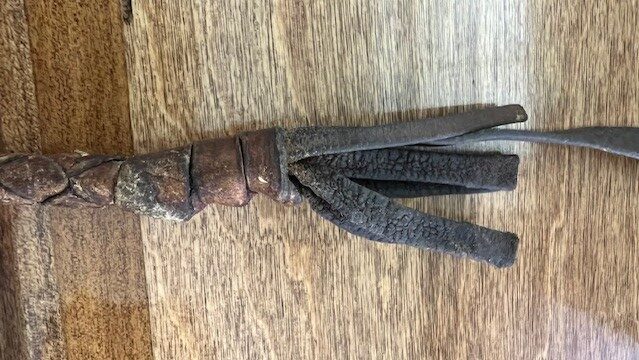
Blurry picture of the “fall hitch”
The bullwhip handle
Better picture of the fall hitch
The whole bullwhip
Better view of the “fall hitch” and whole whip
You can click on the pictures to see a bigger version of them. This bullwhip was made by Joe Strain, and it’s takes a beating in the show, but it still works great!!!
Here’s a quick video of the bullwhip cracking sequence at the Indiana Jones Epic Stunt Spectatular in Disney World. The Indy character is using a bullwhip that’s made by Joe Strain.
I’m still out of town until 2/1, so don’t expect many posts on this blog or me to return any calls/emails until I get back.